
I can go online; Google, YouTube, magazines, even AI, and get information on what photographers have been using to capture images for the past thirty years, all in around five seconds and get a fairly accurate response. Whether what they use is optimal is another story, but the anecdotal information is there, brand and marketing guidelines are there. If I go online and try to find out what to do with those images after they are on your card already? I honestly think there are more articles on darkroom practices than workstation builds. I hear you, well doesn't everyone just use a MacBook Pro? yes, that is the standard but it doesn't not mean that is efficient. When I was in the Army our standard issue service rifle was the H&K L85A2, and whilst better than the SA80 and the later L85A1, it was still a terrible decades old design. Ring any bells? MacBooks are by their very nature of being a laptop, underpowered and overheated.
Just like the SA80 and its decedents, the conversation regarding weaponry only really matters under fire. As I sit here at the start of 2026 we are seeing what is being colloquially referred to as “Ram-pocalypse” due to the current AI-bubble shorting NAND supply. Not only has pricing increased exponentially (Samsung have increased prices 100%) but shrinkflation is abound, with NVIDIA first cutting the mid-tier product line, resulting in increased prices of entry-level SKUs. Then they decided to halt production of all consumer products for six months if stories are to be believed. Ahhh but you already shoot mac, what’s it to you? You mean that closed box with unified architecture and soldered components? By the company that has limited stock of replacement parts and are considering pivoting back to 256GB drives and smaller RAM counts? What happens when your laptop battery dies? That if nothing else has an explicit timer. Not only that but options are closing, Micron has discontinued all consumer goods and shuttered their front-facing brand Crucial. What happens on the left is mirrored on the right.
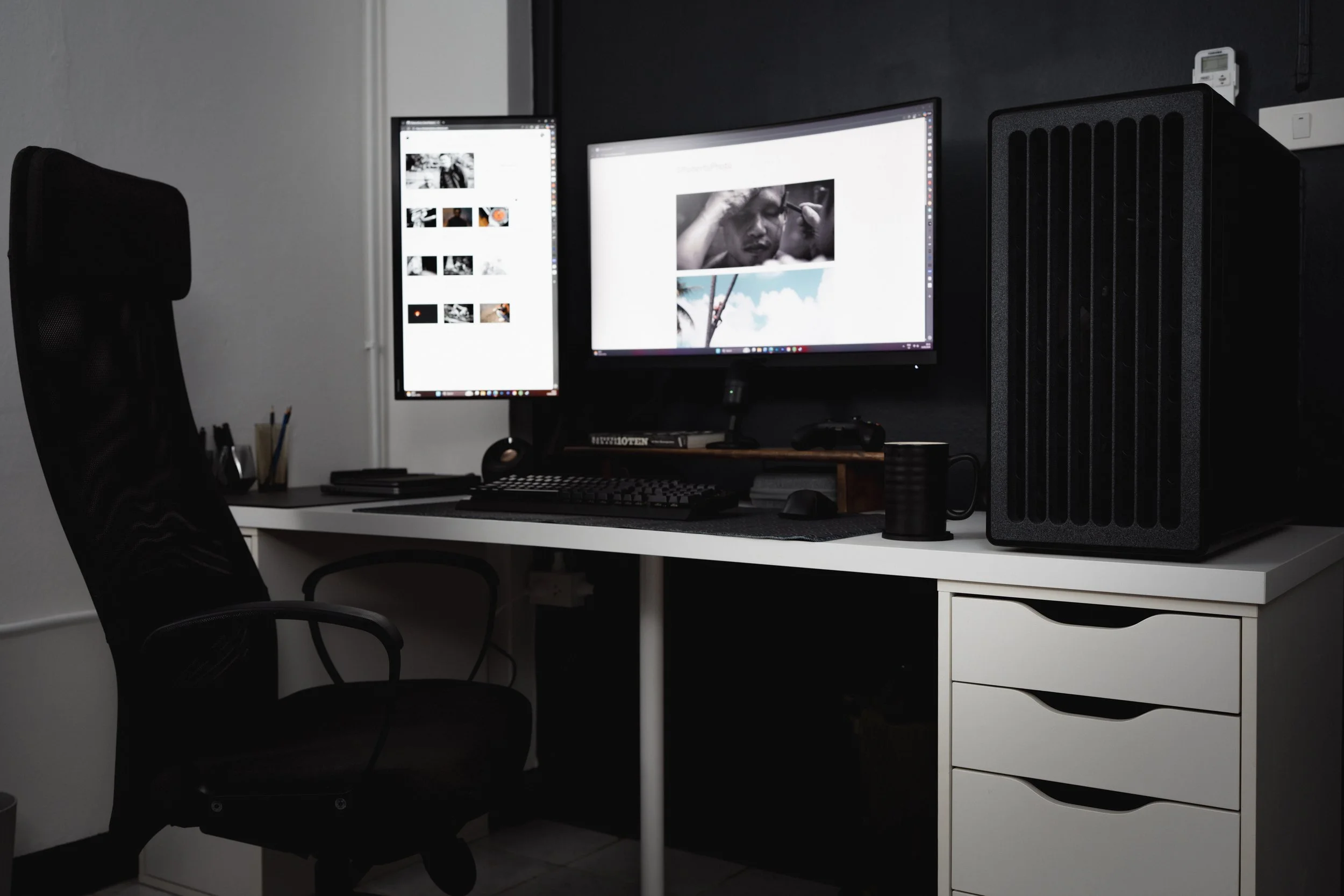
Yamato - the DRobertsPhoto stills workstation, as it is day-to-day.
So the argument is clean cut right? Why buy a locked system that cannot likely be repaired in the very, very near future? Well… if it was only so simple. Apple still has a major advantage over PC; codec. Over on PC decoding codecs are an intensive task, especially for 4:2:2 10 Bit, if less so for 4:2:0 8 Bit (but I'm only touching on motion and we will come back to this later). Of course this also applies to stills, but the process of waiting for a preview is less noticeable than trying to scrub through a hitching timeline. Its become the norm, and for good reason. People accept the terrible render because the actual work feels seamless. I have two Macs here at DRobertsPhoto HQ, and M1 MacBook Pro and an M4 Mini. This isn’t about jumping ship, its about knowing you can’t dock a dreadnaught close to shore, or take a speedboat into open ocean.
Why does any of this matter to you, or more importantly; to me? Because The New York Times staff, Disney funded Nat Geo projects, they won’t care if RAM is 100 dollars or 1,000 dollars. But for you, for me? That’s the difference between a project being made and a project being a dream. We ill reach an end-point where creativity is monopolised, and if creativity is monopolised it means that consensus is made due to homogeneity not meritocracy. Legacy product you say? You really think marketing will support legacy models that are being discontinued in favour of far easier (read worse — they aren’t stocking warehouses full of NAND and putting the bare minimum into high-profit retail units, they are putting the bare minimum in because that’s what they have) products to maintain? Now is the time you hedge against market collapse, you aren’t buying at the peak. You are buying right before a vertical cliff.
The darker truth of it all is none of this matters to most because they produce Instagram-level work that disappears into the cloud; the same cloud that prevents you from making real, meaningful, and long-lasting work. Client work gets scrubbed after the obligatory 90 days. Sizzle reels take up USB-stick space, not server space. And archival-first documentary dies. Long-form dies. The medium as art? Just like film, we will be split between the “real” (6x6, 8x10, High-Res, Large Bit), and the “pretend” (26mp, 35mm canister). Its already happening in real-time, outside of photography releases are being pushed back into the “we don’t need to think about this ever again” parts of the calendar, Fujifilm has openly released their most recent cameras with old sensor technology, heavily reusing both their 26mp sensor that debut in 2018 — that’s seven years ago and was at best a revision of the 24mp sensor from 2016 a decade ago — and the NP-W126 batteries. Flagships from all brands have been conspicuously absent, and yes the GFX100RF proves the rule by being a Veblen good.
As a millennial, and I am sure many of you reading this are (or Gen Z) it is with great sorrow that I announce the end of what has been year on year advancement, year-on-year democratisation of tools. We have come to an end my friend, this is a cold war on creation. I think it is what will finally sort the wheat from the chaff. I may not have a crystal ball, but I do have 20:20 vision, and I’m telling you this breathless from high-ground.
Digital Darkroom
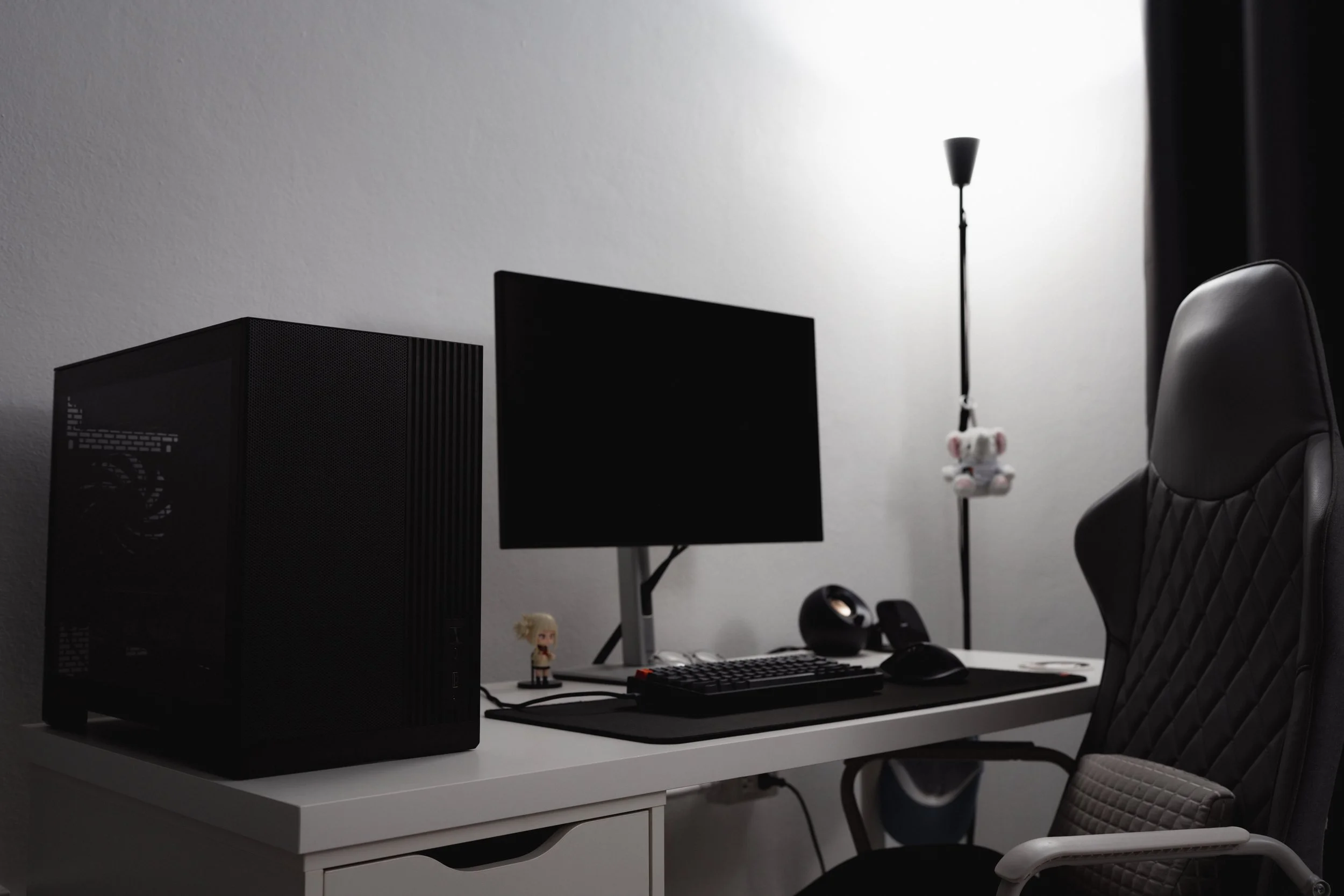
Musashi - Dararat Phetkhon’s workstation for collaborative efforts, as it is day-to-day
I’ve had a workstation for quite a while now, despite having used Macs for most of my adult life. Back in 2023 I built the thing from whatever was on the shelves in Udon Thani post-pandemic for pretty much the exact same reason as I built my most recent one. I was preparing for a move back to Sony, and needed the pipeline wide enough for 60MP files. It took me a whole two years, and two Fujifilm X-T5 purchases before I made the jump but needless to say that system served me well through my editorial, my submissions, and my pitches. It turned DRobertsPhoto into a veritable one-man-studio when it was only me, my stubbornness, and the Thai countryside. It wasn’t glamorous, but it worked. I didn’t want to risk messing with it because I was in no position to replace it. In fact, I’m still not. The fact that I did anyway is how serious I foresee shortage in the coming years.
I was lucky in the sense that I purchased the Sony in September, and upgraded what has become Yamato (named after the battleship) at the same time, avoiding RAM and SSD price increases. I will detail the specifics in the following articles, but I tripled the internal storage, doubled the RAM and increased the read/write speeds by around 1/3. I also approached Angelbird Technologies who partnered with me on Discover Temples of Thailand, providing what is now gold-dust in the form of their 2TB SSD for field-use, intended specifically to house my Chiang Mai catalogue until I return to Udon Thani. I say this only to reinforce the longevity of my plans (regardless of the forced timeline), and the seriousness at which I take this. The idea was that I was to spend on uncompromised capture systems in Q3 2025 and for post-production upgrade to our suites in Q2 2026 once the exact catalogue is known. This was logical, this was correct in a stable market.
Having one-eye on the market, with my project manager hat firmly on, I decided that end year sales would be the only time that I could capitalise on the minor price decreases. Through trail, error, and more money than I want to admit spending, Yamato welcomed her sister, Musashi to the HQ. Initially Yamato was the only workstation to be upgraded, and the leftover components reused and repurposed for a second machine. The failure came not in ability, but in comparison. Yamato shone light in how a system should work for the user, and Musashi did not clear that bar. Initially an i5 machine, it was unable to even keep up with H.265 unless proxies were used. Thinking it may be mitigated by using Blackwell architecture GPUs, I decided to replace the freshly purchased 5070 in Yamato for a 5080, donating the former to Musashi. Yet with a 5070 series card, the imbalance became even more profound, the system was no longer a parts-bin Frankenstein, it deserved an i7. A long and difficult search was ahead for an i7 with onboard iGPU but one was found and fitted.
All the exact parts will be listed in the in-depth look at the systems, but for now the why matters more than the what. After building Musashi into a veritable Ship of Theseus, with every part a new component and not one donated part remaining (unless you count a weeks old 5070), it shone a light where I did not want it shone, just like their namesakes it overshadowed Yamato. In everything there must be balance, and workstations are equally so. With Musashi a perfect mirror to the FX30, small, light, agile, built for single cuts — it made me wonder if Yamato was the perfect partner for my Tonbogiri (my A7RV and 35mm G-Master, named after Honda Tadakatsu’s spear). The question did not remain open-ended for long, it was not.
This is where the workstation lesson lies, it is in balance and necessity. I should have asked myself the question from the first moment; what do I pair with my a7RV? What is enough? It is a question I tried finding the answer to, only to find no one else is asking it. Not correctly anyway, so into the dark I stumbled. The easiest thing at this stage would be to promote Musashi to primary service, demote Yamato to secondary status and live life knowing that I managed to get a deal whilst the tech world burns, but I knew intrinsically, that this was not balanced. Musashi was perfect for what I wanted it to do, it was the perfect vessel for what the FX30 (I should name that too) produces. Also, a part of me was attached to Yamato, it got me where I am, was I to abandon it? Not when I saw potential for balance. I still believe the 5080 was the correct choice, a 5090 is prohibitively expensive. But on the CPU side, there was one more logical rung to climb — the i9.
I have purposefully stayed away from the i9 due to its terrible heat management and overdraw. Heat is my biggest enemy in Thailand, in the field or in the office. The main reason that a workstation is superior to Mac is due to thermal efficiency, water-cooling, fan stacks, even the option for open-air. Even down to sheer design principle, a computer has far more space between components and heat shielding. Components die when they heat cycle often, the key is sustained temperatures and that’s something Mac does well. But unlike PC Mac sustains temperatures by throttling components down to a crawl, not by increasing cooling. It is also why I went with the 5070 initially, as a far cooler running card. This was a problem I now had to solve, how do I dissipate all that heat? My problem prior was mainly turbo spikes as I opened files, something an undervolt fixed. My new hardware does not need to aggressively turbo, but it does run hot.
This led me to learning a fair amount about overclocking, as that seems to be the only niche that cares about thermals. Two products in particular kept popping up again, and again. Thermal Grizzly and Havn.
Overclocking
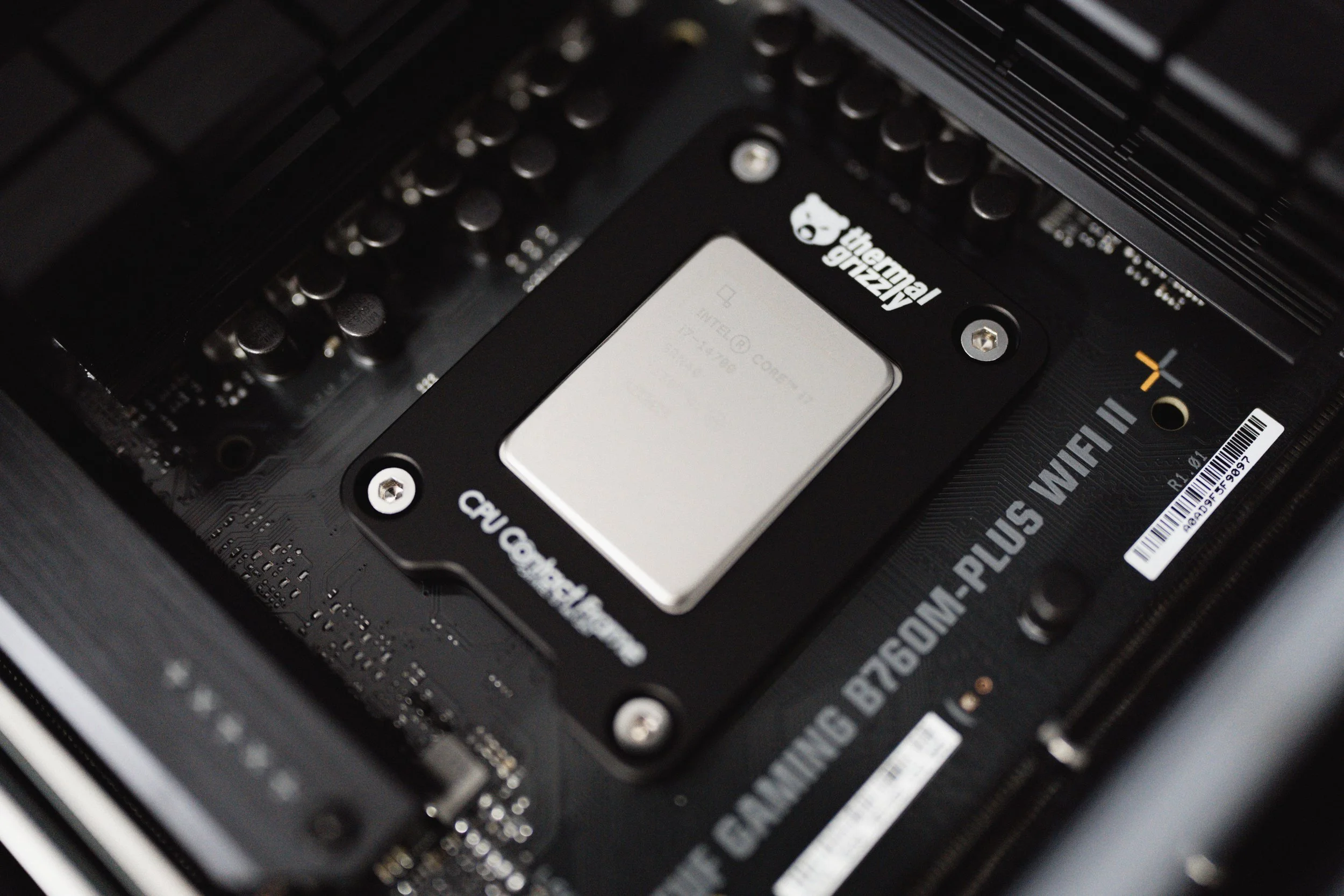
Musuashi’s i7 14700 with contact frame applied
Firstly I discovered why Intel chips were notorious for keeping cool; they are longer than they are wide, and the OEM fastener does not apply enough force equally. Der8auer, the man behind Thermal Grizzly invented a frame made from milled aluminium that replaces the OEM fastener ensuring that even pressure is applied across the chip, meaning that the lid is then contacting the cooler fully. He has also invented one of the best thermal pastes on the market named Duronaut, a thick paste that has good thermal conductivity but even better longevity. The longevity is what makes it impressive, and for a workstation rather than a benchmark-attack machine, exactly what the doctor ordered. The NVMe drives were bolstered by 8W/mK pads, over double that of the industry standard 3W/mK. On a side note; I am constantly impressed by the innovation and skill that I see in other spaces and every time I poke my head out from the photography industry I am reminded of how stagnant and insular it has become. We are talking microns, but enough that it can make a 5 to 10% difference easily. There is no “good enough” or “for the vibes” attitude to be found here, and I find that welcome. If a thing is broke, excuses are not made but solutions found.
Whilst Der8auer and Thermal Grizzly were looking internally, Havn was looking externally. Made up from employees of various reputable case manufacturers and aligned with a single goal of creating the benchmark of what airflow is tested against; they created the BF360. Sister to the BF420 — and much like Musashi, learning from that iterative process — the BF360 is designed to move air. Ambient temperature has a direct affect in internal temperature, but airflow is a cooling method. Of course even at the full 40c summer temperature the room is still far cooler than the components, but when taken in the context of reality and an air conditioned space, airflow is the main component to keeping the system cool and functioning at full speed. So what matters when it comes to airflow? Much like the exposure triangle it is a combination of speed, pressure, and resistance. Speed and pressure are solved by a pair of gigantic 180mm fans, resistance was solved by aerodynamic design including an air dam that leads flow internally.
I spent a lot of money, doubled up on a lot of things I could have done right first time. But the information is not out there, no one has written about how to build a workstation for high resolution photography or even why you should. Now someone has.