
The AI-Bubble (not AI intrinsically) will change the way we need to work, permanently. Any thinking this is a storm that will pass is creating problems for the future. I say this with the utmost certainty; The problems will not go away, nor will they be unanswerable, but the ability for the average person to combat them will disappear. And what is the quickest way to make a car faster? You shed weight, especially unsprung weight (weight around the wheels). You look to aerodynamic efficiency and you look to mechanical grip. None of this is an increase in power, none of this is forced induction or increased displacement. None of this is done at the expense of structural rigidity. When the Yamaha 2JZ GTE is no longer available, you sleeve the block, and you run conservative boost.
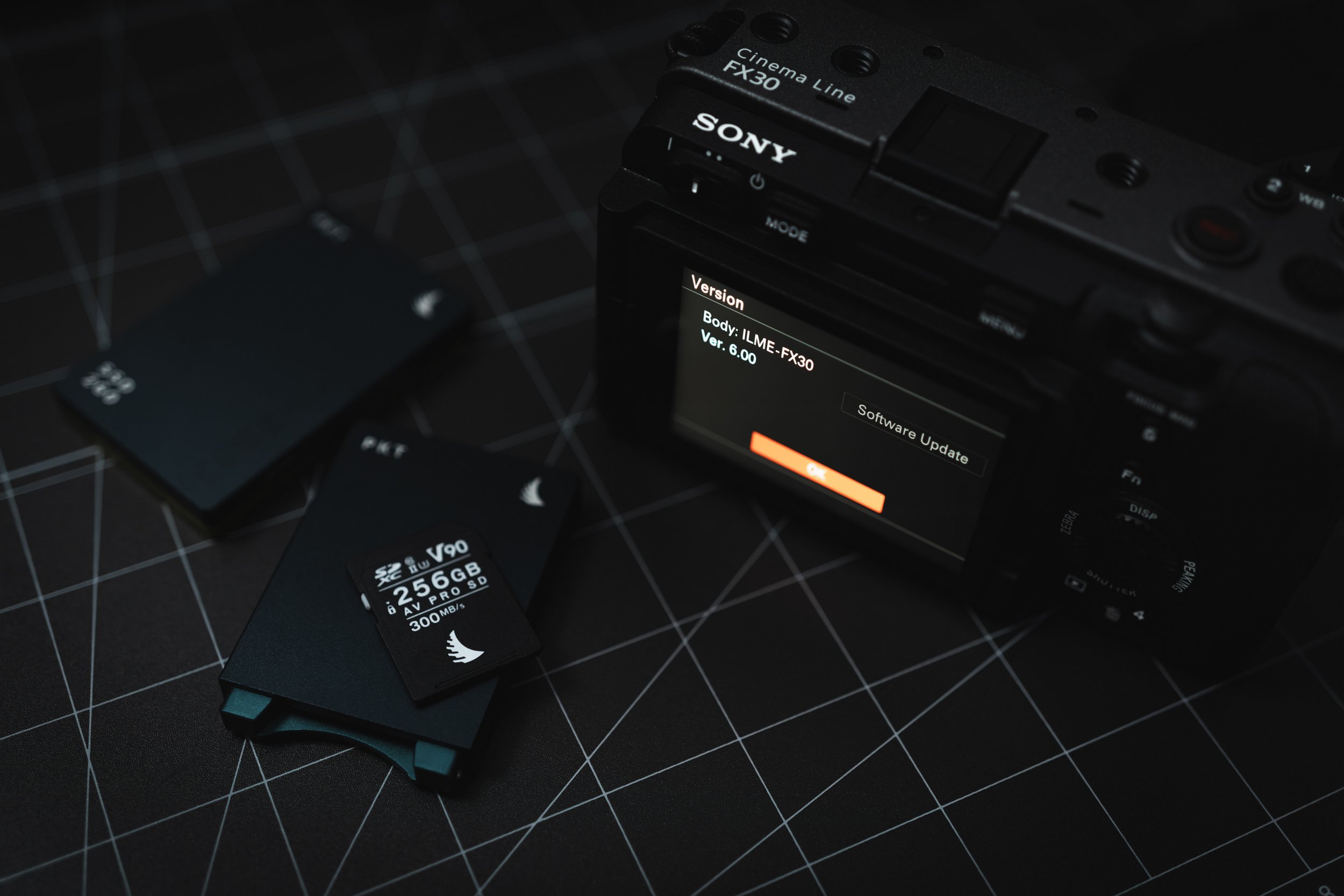
Sony FX30 with Angelbird media (please note: Angelbird facilitated Discover Temples of Thailand)
It used to be the case that when you needed more memory, you bought more memory. Now we are seeing supply chain collapse, shrinkflation and worst of all - technological brick walls by the name of bifurcation. If you wanted another 500MT/s SATA drive? You could hook up half a dozen, if you want 5000MT/s or more from NVMe? Even populating your Gen-5 slot will bifurcate (split data) the instant you add a GPU. Even Gen-4 only allows limited drives — my motherboard allows three at 4x and that’s considered a lot. You can’t just add another Terabyte or two when you need it. Ok so lets just buy 4TB off the bat, well 1TB today in Thailand costs 5,600 for a DRAM equipped end-of-line SN850X, 4TB costs 50,000 (that’s almost 1,6000 USD). As I stated, it isn’t the same as buying four 1TB sticks, firstly most motherboards don’t even have enough space for four, secondly even four 1TBs amount to just 4TB, whereas four 4TB is a 16TB machine. DDR5 RAM only works high-speed in two channel configuration, 32GB currently sits at 16,000 from a reputable brand like Corsair, 128GB? Pre-order only, no RRP. You can’t populate four slots so you are forced into the economics of small enterprise AI repurposing consumer goods. You can buy a four set for around 22,000 THB (or 700 USD) but good luck getting it to play nice or run faster than 4,X00MT/s. What good does RAM play? Both the SSD DRAM and system RAM are what allows fast culls, the exact subject you came here for.
Unless you are comfortable paying those prices in perpetuity (I am sure some of you out there are), then the only real option you have is to decrease output; You either decrease volume, which is often not a possibility unless you are a machine gunner — in which case remember that even a stopped clock is right twice a day — or you decrease size. I will do neither, I shoot the amount I need to guarantee a usable catalogue, I shoot RAW due to data integrity for post production, I shoot high megapixel counts for multiple reasons tied to house style, image fidelity, deliverable expectation, and archival implementation. Perhaps shooting JPEG fits you, or going down to a 33MP or 26MP file, all perfectly adequate for Instagram’s new-and-improved 1440p resolution. I am sure “friendly, usable, easy” is quite marketable for the next round of shrinkflation and gaslighting from camera manufacturers, but it all leads to the same place; public denunciation and wholesale devaluation of the medium.
I quickly realised that if DRobertsPhoto is to survive the theatre of 2026, building my workstations Yamato and Musashi, is not enough. In history Yamato was defeated by the U.S.A.F during Operation Ten-Go, sent as Kamikaze defence of Okinawa, where the crew never made it to land. Yet unlike the U.S.A.F bombers, the Yamato (and by extension—the crew) is immortal. The explosion of the Yamato was the largest non-atomic explosion recorded in military history, seen for miles. Sometimes the war is lost, but peace is won. I do not think I will win, not against Instagram, not against influencer culture, not against AI giants, but I will fight. If this is my last explosion, then let it be seen and remembered.
My Workflow
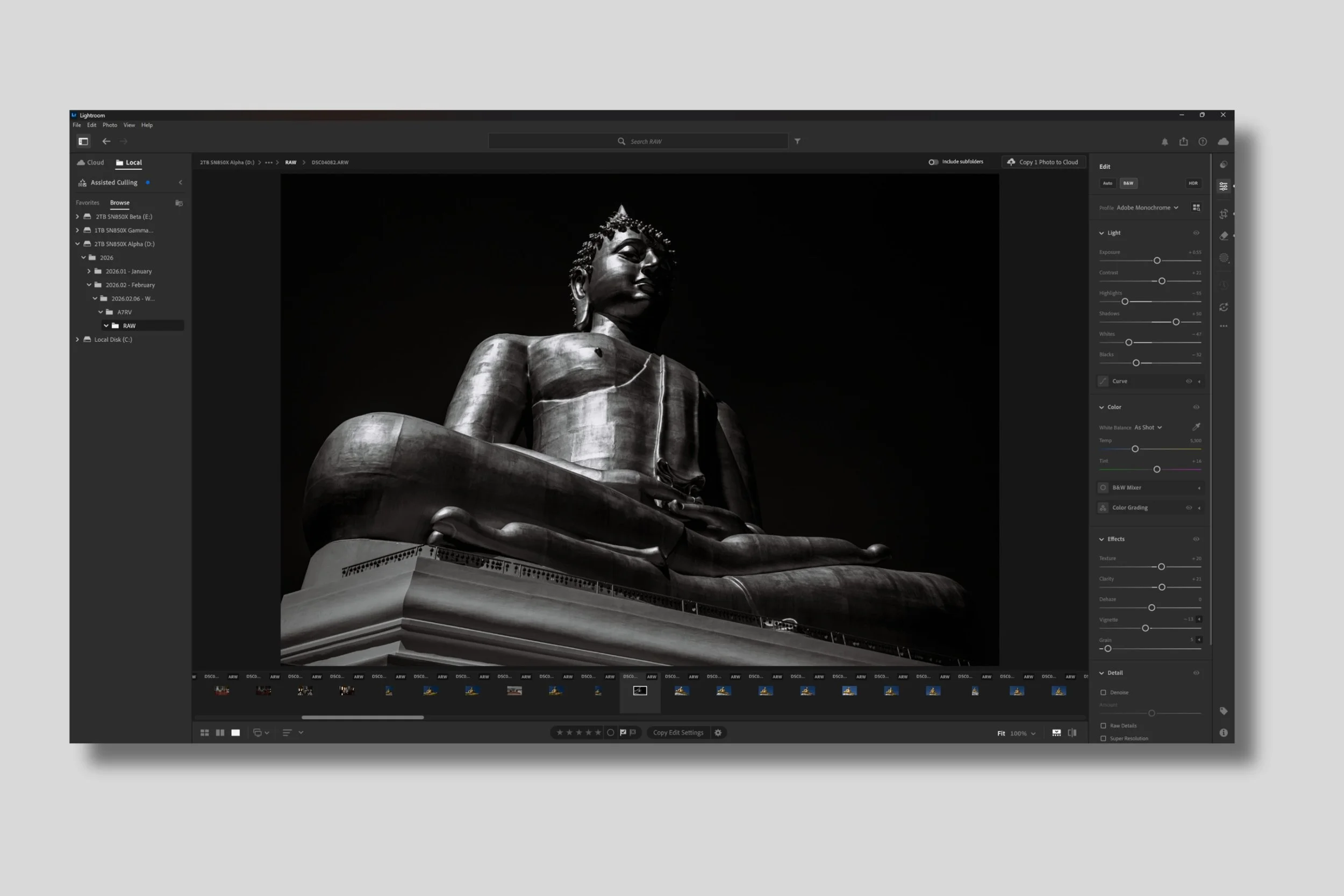
Lightroom catalogue - note manual folder designations and bracketed approach to imagery
I wrote this in one of my Production Field Reports for Discover Temples of Thailand just a few months ago “It is now October 12th (2025). So far I have fallen into a rhythm of one day out shooting, followed by a day writing these field reports and general data hygiene. I would like to be able to get to the point where I can do this blindfolded in an hour or two after getting back from a day’s shoot, and I am sure it will get there.” and I could not have been more wrong, the one-on/one-off is the future we must embrace, perhaps even one-on/three-off, as with AI how we make the images matter as much as where, what or why. The cull has become even more important, and when things get important you slow them down. The proof is important, the method and methodology, possibly equally if not more important than the work itself, for if someone does not plant wheat the next harvest will be empty.
I’ll tell you all my workflow so you can then file it and get on with the lesson at hand. I shoot dual card RAW no lossy formats, no compression. Volume is my best friend, and as they say ‘two is one, one is none” so a single set for me is four 256GB cards that are intended to produce one set of images. The images mirrored onto the cards inside the camera, and the spare as insurance in my waterproof card holder. This is my baseline. I keep the primary card 1 inside the camera at all times (unless the card fills, but that is rare) and will remove card 2 for data ingestion, This is the part of the process that is most vulnerable to data loss and corruption, mitigated by card 1 sitting peacefully inside my camera. Once the images are offloaded into the specific folder — File Format inside Camera inside Year.Month.Day - Location, Subject inside Year — then the volume and contents are checked against the card (for instance 140GB, 340 items). If this is correct then the folder Year.Month.Day - Location, Subject is copied manually from my primary 2TB SN850X to my secondary 2TB SN850X’s Year folder. This takes seconds. I check to make sure everything is present, then that file is never touched again. This means that I have two identical copies of my day’s catalogue on two high-speed NVMe drives that are resistant to corruption. Only at this point do I format both cards inside the camera, this way even if I forget pre-shoot prep, it is ready to go.
Weekly I will transfer the new Year.Month.Day - Location, Subject files manually to a 24TB external Seagate platter (to which I am considering purchasing a second, mirrored drive) and never touched again. Once on the Seagate 24TB archive, the same will be done but from the secondary SN850X to a 5TB WD Passport hard drive, and if images are ever deleted from the NVME this is where they will be indexed for recovery. The images are always copied from the secondary drive, be it NVMe or hard drive. this is because the primary NVMe is for editing and contains sidecar files, and the 24TB Seagate is the archive, not the library. The 5TB WD is the library, and when at 4TB capacity is considered full and a replacement is purchased for the next batch. Edited files are kept on a folder titled DRobertsPhoto and in the subsequent folder to which project and deliverable it belongs. This folder lives on all drives simultaneously.
For visual aid:
SN850X 1TB (Drive C) - OS, Adobe and exported JPEG (sometimes TIF).
SN850X 2TB (Drive D) - Primary RAW files and sidecar files.
SN850X 2TB (Drive E) - Untouched RAW files for handoff to cold storage.
Seagate 24TB (Drive A) - Archived RAW files.
WD Passport 5TB (Drives F and on) - Indexed Library RAW files.
Drive D and E are used like a kitchen countertop, when the meal is finished it is cleaned. The hard drives are like a pantry and cupboards, where you store the ingredients. The pantry (Drive A) is full and the cupboards (Drives F and on) have what you need to hand. As stated prior, all drives have the exported files, but they are only ever used from Drive C. I have every single image from every single camera since 2016. This is now dead — no longer viable. Not only because there is limited room on Drive C and A, but because there will now ALWAYS be limited room on all drives in perpetuity.
But I do have a fix, and its bitter medicine. There has to be a new step, one where the cards sit in the camera a little while longer and you sort through everything on Drive D before mirroring what is left onto Drive E. This means you must be ruthless, in the cull, but also in the field. It means that pre-production becomes more intensive, projects become more selective. For many, this means your output will be better, for others it means that growth will slow, advancement will halt, fear will drive. We see it in modern photographers who can barely finish a 32-roll of film, Peter McKinnon publicly spoke about it; indicting his own sensibilities whilst doing so. If he cannot find thirty-two things worth saying with his Leica then what value does his hundreds of videos and thousands of images have? You don’t stop driving because gas is expensive, and you don’t put 87 octane into a high compression engine. You don’t sacrifice seat time because rubber is unaffordable, but you don’t change one corner at a time either. You change intent. You change environment.
I usually shoot three or four images of the same subject; to make sure I have the exposure I want, framing I want. If its humanistic, the expression I want. I can reduce a good 60% — if not more — of my footprint. I made the pivot to Discover Temples of Thailand already, temples don’t move or change as you photograph them. I can approach them at my own pace. If I listen to my own words that street photography is for training the eye, not the archive? Then once training is complete we do not dwell on the bruises. If we refuse to feed the algorithm, something I have done for years now, then the pressure is off to sit on a mountain of images to hit that “perfect time” or “perfect hashtag.” I won’t be going to JPEG or a 26MP workflow, I just realised that the road is narrower, there won’t be larger options. Yamato has 2TB countertops, and for what its 5TB cupboards once costed, I may only get 2TB in the future. I can adapt now, or I can adapt after.
I won’t let the market dictate my vision, and no visionary ever let technical limitations get in the way of the work. I draw from a wealth of past lives: soldier, mechanic, manager, musician. It is the only way to ensure that photography remains photography. It is the only way to realise that the path doesn't end because they put up a “No Trespass” sign on a public road. Plus; I never did well at listening when authority began to dictate.