
2027 marks the ten year anniversary of DRobertsPhoto.com and 2026 of my photographic journey. I have decided to compile the events of the past decade as an independent photographer chasing mastery in an industry chasing metrics.
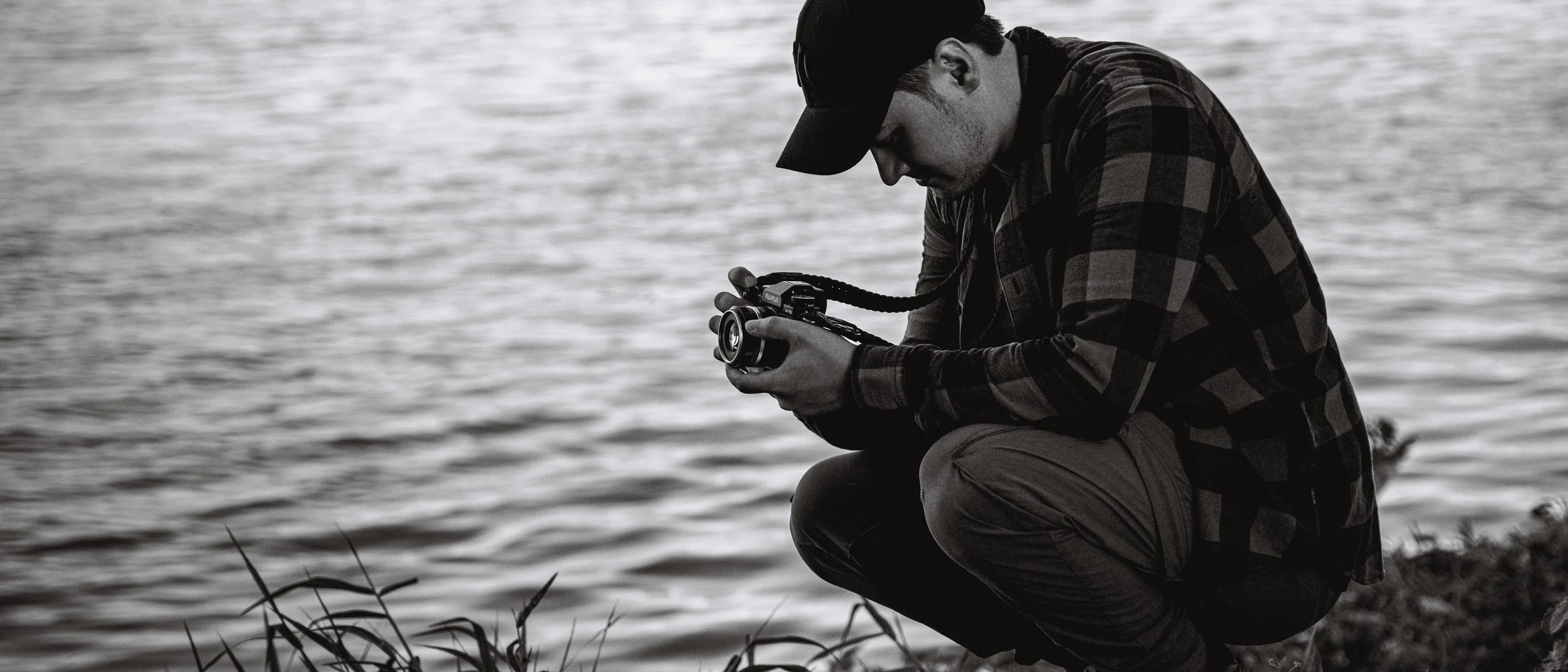
Photographing fishermen on the banks of a Mekong tributary during work on Manual Lenses for Nostalgic Imagery for FUJILOVE Magazine, integrating documentary ethics into commercial editorial.
As with Discover Temples of Thailand I will not just be documenting my decade-long journey prior but the very process in which I will be tackling a retrospective. Although we are only just approaching the end of 2025; health issues dictate that I spend more time in the office and less in the field. I believe it is the prime time to asses what materials I have from these past nine years and begin assembly of what will be my first retrospective.
My first hurdle that I have faced is even accepting that a retrospective may be the best course of action for DRobertsPhoto and my current positioning. I am very adamant in the separation between legacy creators (whom I have much respect for, and relationships with many) and myself. I pride myself on being contemporary in the truest sense, that I am actively creating and actively challenging the status quo with avant-garde ideals. As such a retrospective is the absolute antithesis of DRobertsPhoto if one is to look at the word semantically.

Political rally in Bangkok following the first election post-Junta.

Tradition Thai Khon performance featuring Hanuman .
I admire the work of many Asian photographers who have produced work trough the late 1980’s to early 2000’s but my standing and the industry status quo are worlds away from what once was. Firstly, their perspective is Western, and comes with the inherent bias of a Western-eye. My dual-nationality mitigates this. For those who wish to achieve what was once possible, emulating these photographers is now impossible. In-roads and paths to these careers are dead. I am able to connect with these photographers as they captured the Thailand I was raised in, before concrete dominated, as such I feel much kinship. However, through many conversations I have come to realise that East or West, this is no longer their world. In this way, I believe a ten year retrospective of my work arguably will have greater merit in the current discourse.
What I propose will be a twofold opportunity. Internally, it will be an opportunity to re-asses the steps that led me to this point, and allows me to continue in a way that does not endanger my health further. Externally I will attempt to blend what I have learned from writing Too Quiet for the Algorithm Too Loud for Any Room (which leaned heavily on biography to assert it’s manifesto) to create a retrospective that spans biography, technical pedagogy and personal manifesto. This way it will not be an egotistical piece of self-congratulation but an extension of the essays and field reports I have been creating independently (post-editorial). I have taken the mantle of Promethius and I belive that a ten-year retrospective would be the kindling that the photographic community needs. For the industry to change — consensus must change. This is a valuable lesson I have learned from Discover Temples of Thailand and my interaction with the industries leading houses.
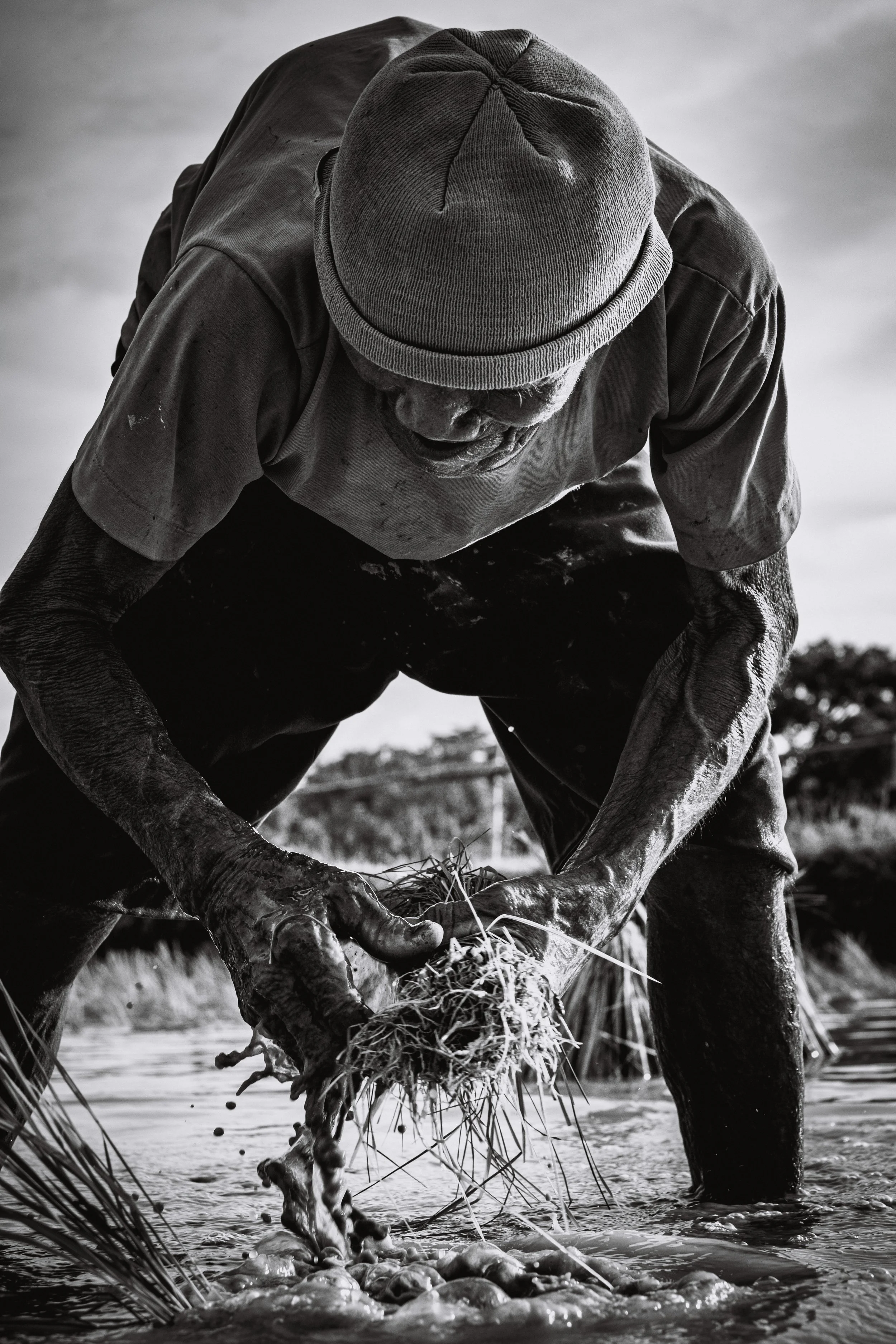
77-year old Bunmi planting rice, as he has done year after year.
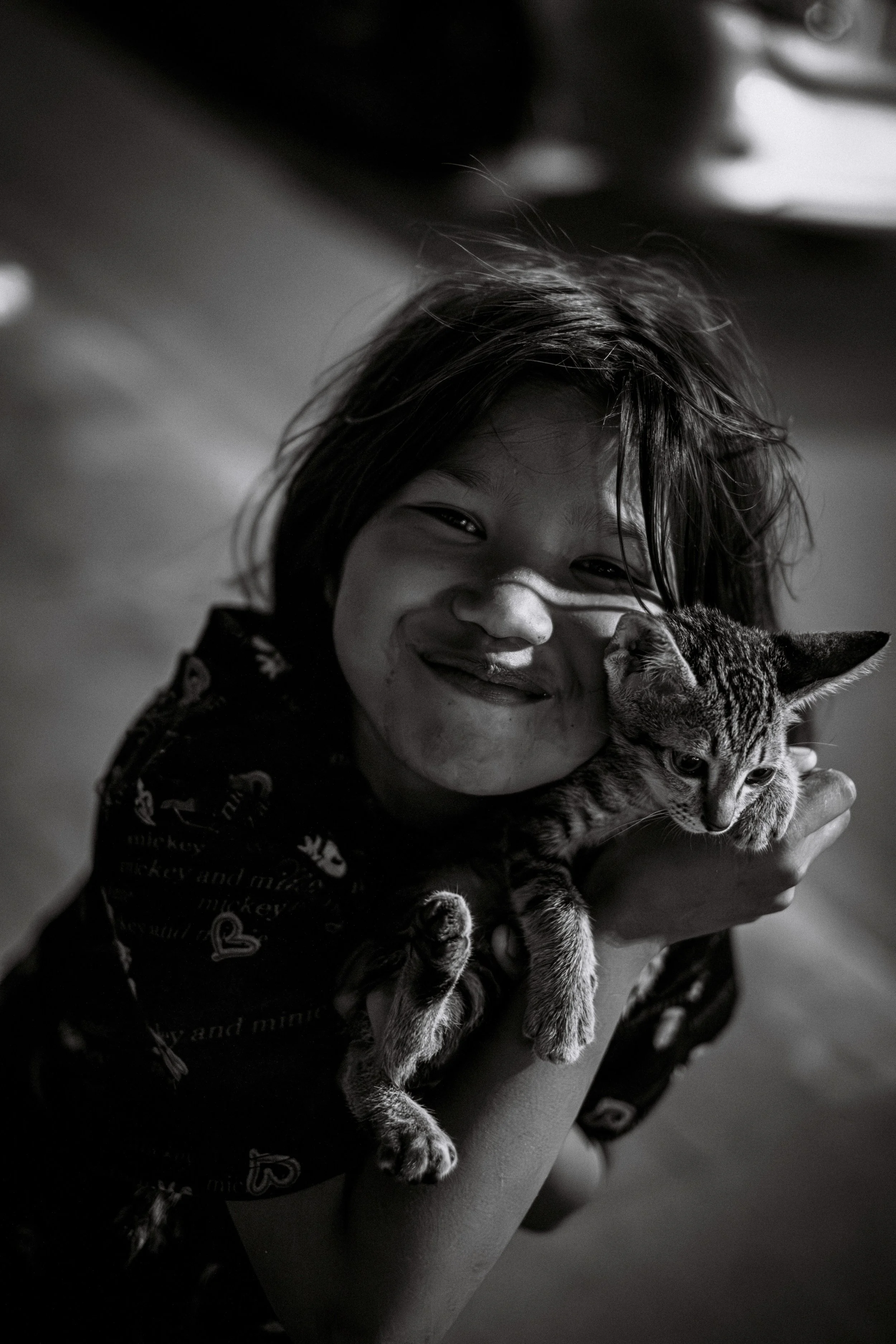
A girl and her cat, happiness is found in her feline companion.
The work itself — in this ideation phase — is heavily inspired by Katsuya Terada-Sensei’s Ten. His ten-year retrospective does not focus on continuity but embraces his array of works from character design to his few short-form series such as The Monkey King. This work is heavily annotated and even contains highly developed but ultimately unfinished ideas. I believe this mirrors my position within photography, as the retrospective will be the cradle; the formation of who I am and what DRobertsPhoto is — rather that what it was. My work spans multiple countries across Asia and Europe, multiple technical trials from film to digital and across brands, from independent roots to editorial and back again to independence. This is a journey that no other contemporary photographer can claim, especially to the extent of institutional and industry interest I have garnered. My journey is not that of education to fellowship or in-house salaried work, or most important of all; it does not reflect the current wave of social media centric independents.
At this stage my thoughts are that by separating the retrospective into distinct categories I will be able to reach the people who need it most: be it creatives who are here of ideology, technicality or those invested in the work itself. By separating it into Camera Lineage (pedagogy), Location (Biography), and Projects (manifesto) I am able to tackle specific issues in micro whist retaining macro context. How this ultimately pans out only time will tell. The working title will be Ten Years of DRobertsPhoto with the subheading A Retrospective of the Formative Decade* but I may change this to DRobertsPhoto: The First Decade or DRobertsPhoto: A Decade of Iconoclasm if the end product leans literary
*Currently subtitled The Birth of Philosophic Documentarianism.
Part One: The Trojan Horse
By focusing a whole section on Camera Lineage I am able to open not just my potential audience but the vectors in which I will be able to reach that audience. Not only will this target those who are looking for technical advice, but it will also allow me to approach the likes of Ted Forbes (The Art of Photography), Kaiman Wong (ex-DigitalRev TV), Bellamy Hunt (Japan Camera Hunter), and other public facing personalities with work they are likely to understand and thus amplify. This is not the first time that I have used this tactic, as my editorial contributions (FUJILOVE, Fuji X Passion) have laid the foundations for my professional and technical credibility. Despite my post-social ethos, I am not a disbeliever in social media-as-tool, only in its current place on the industry totem-pole. Leveraging hobbyist enthusiasm is not conceding to metrics-driven discourse but utilising it in an efficient capacity as amplification.
My history with cameras has been varied, ranging from the A7RII (as an early mirrorless adopter), to the Leica M2, Fujifilm X-Pro2, Leica Q, Contax G, Hasselblad 500C, Leica M9, then more recently (in terms of contemporary project use) back to Fujifilm with the X-Pro3 and X-T5 before coming full circle to the Sony A7RV. Optics have consistently focused on Carl Zeiss, Voigtlander, and Leica, though there have been times of experimentation. There are many, many cameras and lenses other than those, but all mentioned have been used extensively in the search for my personal aesthetic.
By separating the technical aspects I am able to keep my biographic sections purely for use in reinforcing my personal manifesto. For clarity, neither my manuscript (Too Quiet) nor the planned monograph’s (Discover Temples) end goals are in being published — but in how they are published. Review by TASCHEN means something, review by House of Anansi means something. Putting ink to paper alone does not. By separating the how from the why within my retrospective, the why remains pure. And who knows? Someone may actually read on…
To a layman the lack of acquisition reads as failure, but to an iconoclast — such as myself — it is proof of altitude, seriousness, and of the current status-quo. In publishing the direct response to 98% of submissions (agented or not) is silence. Then the majority of works (acquired or not) will go through a process of critique. For my work to have passed submission and onto editorial heads without critique is the Rosetta Stone from which I am working. Would this be happenstance I would be less confident, but after an eighteen-month tenure at the head of the Fujifilm community (nineteen articles in the two top editorials, spanning seven optical manufacturer collaborations) then having similar experiences with the objective peaks in their respective categories (TASCHEN, Anansi, ZEISS to success with F-Stop Gear, Angelbird Technologies and Dehancer) it becomes a demonstrable trajectory. As this retrospective (by nature of my own work) is not a trophy cabinet but a call-to-arms from one neck deep in the trenches, explaining this nuance sans-ego will be my largest hurdle. Having a dedicated section on gear, mitigates this as the only hook for a lay-audience.
As for now I have yet to come to a decision of whether splitting the whole book into three sections is worthwhile or having the layout reflect the chronological timeline of events and split the annotations into separate sub-headings/groupings.
For example, let us look at the images below. These were taken very early on (2017) using the ZEISS Batis lenses. At the time I did not realise the power my images held. I had inherently noticed and subconsciously opposed, the lacklustre marketing images of these lenses (especially prevalent in YouTube reviews) but yet to understand how to enter the discourse.
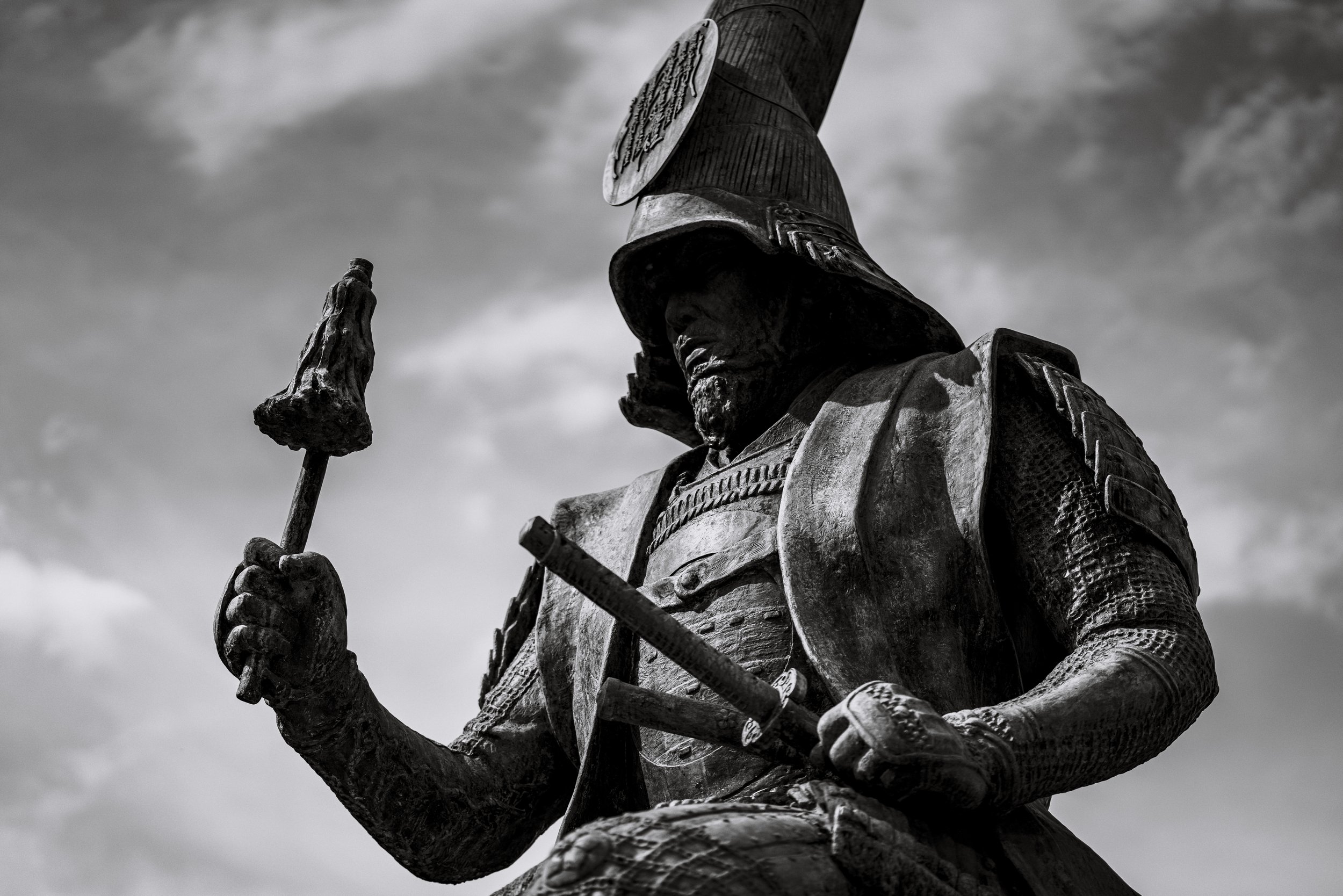
© David Roberts | Sony α7RII | ZEISS Batis 1.8/85 | Adobe Lightroom | ISO100 f/2.0 -0.7 1/6400
An anomaly that you may notice is that I provided settings for the image above. I refrain from providing settings as I believe that to be worst way for a photographer to learn. Depth of field is affected by distance to subject, and the exposure by external lighting conditions. They are not transposable. I have stated them here to prove that even early on basic concepts that followed into my contemporary school of thought were being utilised. The ISO was manually selected akin to how I would shoot film, and I did so in the same way by selecting a low ISO, in this case the Sony’s base of 100. Back on the mark two bodies we would have to manually setup the rear dial as a custom function and use that for ISO, teething issues of mirrorless that I do not miss. I shoot wide open or near wide-open for the majority of the time, informing an individual aesthetic largely irreplicable by the then mobile technologies. It is still a technique I use to this day be it for separate reasons. You will notice I shot at f/2.0 (not quite wide open) and that is sloppiness on my part, I had quickly opened the aperture but not quite fully. Had I not pointed this out you would be none the wiser as it still gives the shallow depth of field I was intending. The third piece of data is the smoking gun in this trail against 2017 David, I was shooting Aperture Priority. Not inherently a bad thing (I often utilise automated modes) but I can tell from the file that I was still falling into the beginners trap of shooting for what I saw on the screen, not predicting the greatest data for the sensor to capture. Luckily the Sony saved me, or perhaps it was the slightly overcast sky that saved the exposure, but I was still able to pull my highlights and push my shadows as needed. You can really see the formation and basis of my technical style even as far back as 2017 and how that eventually manifests in the overall aesthetic of my entire catalogue.
More important than this, it is obvious that from the get-go that I knew exactly what I wanted to photograph. This is — in my educated opinion — the largest thing that most photographers, at any stage, lacks. Most in the industry either lack a true why or lack a superlative how, a blending of both is rare and valuable. The figure above is a bronze depiction of Kiyomasa Kato situated outside of Nagoya Castle, a fortress for which he was the architect. I was never chasing photography for photography's sake but trying to capture and present my ideals. Stoicism is generally considered a Western practise, but many traits are shown in figures such as Kiyomasa Kato, who is known for his command during the Imjin Wars under Hideoshi Toyotomi during which a widely publicised rivalry with Ishida Mitsunari Ishida occurred that led to his support of Ieyasu Tokugawa.
Part Two: The Timeline
DRobertsPhoto as we know it started in 2017, first on Instagram under the moniker @DRobertsPhoto and then later DRobertsPhoto.com. Prior to that in 2016, I consider the start of my “serious” photographic endeavours, especially the purchase of a Sony Alpha 7RII, ZEISS Loxia 2/50, and Voigtlander 15mm Super-Wide Heliar f/4.5. I had lusted over the A7R for so long that Sony had already released it much improved iteration. It was an investment in self, and my push down this rabbit hole. It wasn’t just the purchase of the kit that I deem formative, the kit was purchase to coincide with my return to Thailand.
The journey itself looks a little like this:
Thailand 2016 (A7RII, Loxia 2/50, Voigtlander 15mm f/4.5)
UK 2017 Q1 (M42 obsession: Pentax S-M-C, Zeiss Jena, Meyer Optik Goerlitz)
Thailand 2017 Q2 - Simple Nothings Zine (ZEISS Batis/Loxia, Fujifilm X-Pro2)
Japan 2017 Q3 - From Nippon With Love Zine (X-Pro3 & Canon Serenar 50mm f/1.8, Leica M2 & Summaron 35mm f/2.8, Fujifilm ACROS 100, 100 Yen Fujicolor, A7RII and ZEISS Batis/Loxia still plus an A6500)
Taiwan & Thailand 2017 Q4 ( Leica Q, Contax G1, Carl Zeiss 2/45, 2.8/90, Rollei Retro 80s after ACROS was discontinued)
UK 2018 Q1 - Creation of DRobertsPhoto.com and Cornwall (Leica Q, Contax G1, Carl Zeiss 2/45, 2.8/90, HP5 Plus)
Thailand 2018 Q1/Q2 - Praise from Leica Society & Monogram Asia for Chiang Mai work ( Leica M9, Leica Q, Leica M2, Summicron 50mm f/2, Summaron 35mm f/2.8)
Italy & Romania Q3 - Failed Roman ruins project on 120 Film - X-Ray destroyed by Constanta Airport staff leading to my future aversion of the medium (Hasselblad 500CM, Carl Zeiss 80mm f/2.8, Leica CL, Leica M2, Summaron 35mm f/2.8 Leica R5, Summicron-R 50mm f/2)
UK 2018 Q4 - Personal hiatus, shift away from photography (General Manager at Cardiff Motorcycles)
Thailand 2019 Q2 - Personal hiatus, shift back to personal image making (A7RIII & Batis, A7RII and Loxia, Fuji XF10)
UK 2019 Q3 - 2022 Q3 (Pandemic Years) - Birth of then unnamed Discover Castles of Japan and manga studies (X-T3, Fujinon 90mm f/2 Fujinon 50mm f/1)
Thailand 2022 Q3 -2027 - Initial Indie and Instagram projects: A Hard Worn Road, No Other Time…. But Now, Thailand: 2566, Visual interviews. Fujifilm editorial & brand collab years (inc. six-part Manual Lenses for Nostalgic Imagery with FUJILOVE Magazine, Thypoch, ArtraLab, Laowa and more) followed by TASCHEN review, ZEISS partnership negotiations and the birth of Philosophic Documentarianism - Soul of the Planet, Heart of the People, Discover Temples of Thailand, and One Year, One Lens (too many lenses to list, X-Pro3, X100V, X-T5, Canon RP, Sony A7RV)
The lions share of the retrospective will be given to Discover Castles of Japan (through its various iterations), Soul of the Planet, Heart of the People, and Discover Temples of Thailand. The final years are actively being written by choosing the final projects: One Year, One Lens for 2026 as return to the A7R platform a decade after the A7RII, and The Nakasendo Way in 2027, closing the decade with a return to the beginning; whist simultaneously and opening for the next decade.